
.png)



Most companies offering QA testing services look similar on paper. Capabilities lists match. Pricing comes in around the same range. References check out. The work is where the right QA testing partner distinguishes itself.
A capable QA partner answers the questions that matter before users do. Does checkout fail on certain devices or browsers? Did the latest build introduce a regression in account settings? Does a workflow break under repeated use or unexpected input? Those findings give teams something to act on. Ship the release. Hold a feature. Fix a defect before it reaches production.
Consistency makes that work sharper over time. When the same QA partner stays with a project across multiple test cycles, they learn where the system is fragile, which integrations tend to break, and which changes carry the most risk. Testing gets more targeted with each release instead of starting over from scratch.

What to Define Before You Start Looking
Most teams come to a QA conversation with some version of the same starting point: we need testing. That's not enough to evaluate anything. Before comparing QA outsourcing options, define what you need a partner to validate.
Clarify Your Technical Requirements and Testing Scope
The first question is what needs to be tested and how. The answer shapes every conversation that follows.
Types of Testing
Start with the types of testing your product requires. Different types of testing in QA serve different purposes.
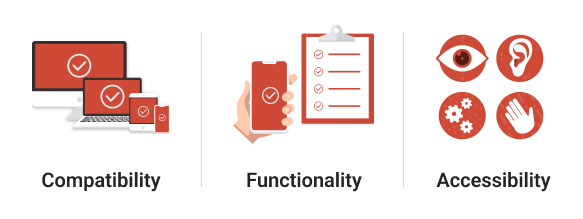
- Functionality testing confirms the product works as intended across core user flows.
- Compatibility testing ensures the product performs consistently across devices, browsers, and operating systems.
- Usability testing evaluates whether users can navigate and complete tasks without friction.
- Accessibility testing confirms the product works for users with disabilities across assistive technologies and device configurations.
- API testing verifies that payment gateways, third-party services, and backend connections communicate correctly.
- Localization testing confirms that language, formatting, and cultural context work correctly within the application for each target market.
Knowing which combination applies to your product narrows the conversation immediately.
Device Coverage
Device requirements are more specific than most teams expect. Mobile applications perform differently across manufacturers, screen sizes, and OS versions. Web products render differently across browsers and operating systems. Define whether you need physical device testing, emulation, or both — and identify the specific configurations your users rely on most.
Turnaround Time
Some teams need results within a sprint cycle. Others need findings before a hard launch date. The right QA testing partner should be able to work within your schedule.
Determine the Level of Expertise and Domain Knowledge You Need
Defining scope answers what needs to be tested. Finding the right expertise is harder. A QA company that covers the right service categories but lacks relevant experience will still slow you down.
Domain Knowledge
A QA partner with experience in your industry understands the workflows, compliance requirements, and failure modes specific to your product type. Regulated industries have different testing demands than consumer apps. A partner who has worked in your space will ask better questions from day one — and know which answers should concern you.
Tech Stack Familiarity
Industry knowledge only goes so far. A QA partner also needs to be comfortable working within your development environment — your CI/CD pipeline, your deployment process, your bug tracking and reporting tools. A partner unfamiliar with your stack will spend the first weeks getting oriented rather than finding defects. The faster they can integrate into how your team works, the sooner testing produces results.
What to Look for in a QA Testing Company
First, it’s important to understand organizational priorities and what you’re looking for in terms of outsourcing QA. Often, with ever-changing development cycles and other unforeseen circumstances, the QA phase of a project can come at a moment’s notice. You may need to outsource help quickly. Other times, you may prefer a partner who can provide services for a prolonged period of time–on an inconsistent basis. While there are a myriad of testing partners to choose from, a careful analysis of your requirements will help to narrow down your search. Here are three areas to put at the top of your list:
- Experience is the first filter. How long has the company been in business, and what kinds of products have they tested? A QA partner with 18 years of work across web and mobile platforms has seen failure patterns that a newer operation hasn't. Ask for past clients or case studies that reflect your product type.
- Location shapes how testing fits into development. A US-based QA testing company works within the same business hours as your team. Defect triage happens in real time, questions get answered the same day, and the QA team delivers findings while development is still active. The same cannot be said for offshore QA testing services — a 12-hour delay between a question and an answer is a half-day of blocked development.
- Capabilities define coverage. Physical devices or emulators. Manual testing or automated regression. Functional testing or a fuller range of services. The combination a QA company offers determines what they can find and where they'll fall short.
- Testing requirements change as products grow. A partner whose capabilities stop short of where the product is heading forces a replacement at the worst possible time — mid-development, when continuity matters most.
- Communication is easy to evaluate before you sign anything. Do they respond quickly? Are answers specific or generic? Do they ask clarifying questions about your product, or do they pitch a standard package? How a QA company communicates during a sales conversation reflects how they'll communicate during a defect cycle.
- How discussions feel matters as much as what gets said. A partner worth hiring asks about your system architecture, how often you release, and where problems have appeared before. Those questions signal they're building a testing approach around your product, not fitting your product into their standard process. If the questions stay generic, the testing will too.

Red Flags When Evaluating QA Testing Services
A QA testing company with no physical device lab has a coverage gap that virtual environments can't close. Emulators and simulators miss what only shows up on hardware — touch input inconsistencies, rendering differences across manufacturers, and performance under real network conditions. Those are the defects that make it to production and come back as support tickets.
Pre-determined testing structures with no flexibility are a warning sign. Testing should be tailored to your product, your release cadence, and your risk areas. A partner that runs the same checklist every cycle regardless of what changed in the build will miss defects tied to recent updates. The plan should evolve with the product and pivot when the schedule or budget requires it.
No experience in your industry or product type is a gap worth taking seriously. A QA partner unfamiliar with e-commerce checkout flows, IoT device behavior, or localization requirements will take longer to get up to speed and may miss domain-specific failure modes entirely.
Poor communication makes every other problem worse. If early conversations are slow, vague, or one-sided, defect reporting will be too. Teams need a QA partner that flags problems clearly and quickly — not one that delivers a report at the end of the cycle with no context.
Hidden fees and confusing pricing structures create friction throughout a QA engagement. Features get added, timelines shift, and device coverage expands. A partner should be upfront about how pricing adjusts before the work begins.
Questions to Ask Before Hiring a QA Partner
- How do you decide what to test first? A strong answer references recent code changes, known risk areas, and critical user flows. An answer that describes running a preset script from start to finish will produce testing that misses the defects that matter most.
- How do you handle regression testing across repeated releases? Look for an answer that explains how previous defects and recent changes shape the next test cycle. Coverage should build with each release, not reset.
- Can we see a sample defect report? Reproduction steps should be clear, affected environments listed, and severity immediately obvious. If the report requires a follow-up meeting to understand, it will slow triage.
- How do you stay coordinated during active development? A QA partner that participates in sprint reviews and defect triage keeps findings relevant. One that operates independently of the development cycle delivers results too late to act on.
- What do you do when behavior is unexpected? The answer should go beyond logging the ticket. Strong QA testing services investigate, gather environment details, and determine whether the issue is a true defect, a configuration problem, or undocumented expected behavior.
- Do you test on physical devices? The answer tells you immediately whether device coverage reflects how users actually use the product or how it behaves in a controlled test environment.
Final Thoughts
At the end of the day, taking time on how you choose your best testing partner will make a difference in the development lifecycle as a whole. When it comes to selecting the best testing partner, there are many factors to consider. Overall, the best testing partner will be flexible and adaptable, and they will also be pleasant to work with. Most importantly, they will understand your company's product goals, and blend in with your org's style of working.
If you are ready to take the next step, please reach out with any questions about our QA testing services. We will provide a free consultation to better understand the scope of your project.